Music Learning and Teaching in Infancy, Childhood, and Adolescence (Oxford Handbooks) by Gary E. McPherson & Graham F. Welch
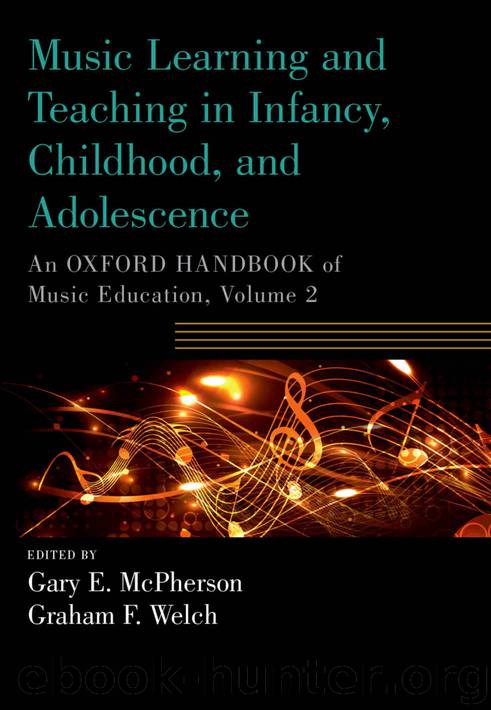
Author:Gary E. McPherson & Graham F. Welch
Language: eng
Format: azw3
ISBN: 9780190674595
Publisher: Oxford University Press
Published: 2018-04-26T06:00:00+00:00
CONTEXTUAL LEARNING: BEYOND THE “UNIVERSAL ELEMENTS” APPROACH
It would seem meaningless if music education merely focused on enabling children to learn and hone a discrete set of musical skills and knowledge prescribed by the music teacher and/or educational policy without any connection to their real-life encounters and contexts. Furthermore, there are real-life encounters with music aplenty in the multiple worlds of children, particularly in this age of technology and mass media. Perhaps, as Jones (2007) suggests, “it is the development of musicianship for personal musical agency in genres students can and will choose to use in lifewide and lifelong settings that is the primary raison d’etre of music education, not the introduction of or knowledge about particular genres for its own sake” (p. 16). Culture and what happens in the teaching of music in the classroom should be intricately intertwined and should never be seen as distinct and separate entities. By living within their culture,
children learn the role of music within their society . . . and the musical grammar they develop is a result of what sounds come into their ears. As they grow, children are developing a sense of their musical heritage, for it is apt to be their own soundscape of live and mediated expressions. Their inventions of a musical nature derive from this musical sound-surround. (Campbell, 2006, p. 433)
Thus, music educators need to recognize and approach both cross-cultural and culture-specific facets of music teaching and learning (Campbell, 2004; Campbell & Wiggins, 2013) and “strive to maintain a musical-artistic focus in the design of curricula, with due regard for the ways in which musical activities and ways of thinking about music relate to the wider beliefs and values of the societies concerned” (O’Flynn, 2005, p. 195). Music curriculum can and should also be linked to “the practices of performers in that society, that is to say, to living traditions of music, as opposed to curricula that are exclusively framed on developmental stages and/or ‘universal’ concepts of music” (p. 198).
The “universal” concepts or elements approach is one that has held primacy in many primary and elementary school curricula since its inception in the 1970s. In this approach, sonic and structural characteristics of music (such as pitch, rhythm, and form) are identified on the basis of having “universal” applicability to all music. Although the rationale for this approach was originally based on an endeavor to broaden children’s understanding of music beyond the Western classical canon, it can result in the atomistic exploration of musical concepts or elements, without generating a real understanding of the music as a whole. The imposition of these Western elements as a way of conceptualizing all musics may also provide a misrepresentation of music, as music is conceptualized in different ways within different cultures (Dunbar-Hall, 2000; Nzewi, 1999).
Campbell (2004) has provided suggestions for gradually moving from an approach based on understanding of “universal” musical elements or concepts in world musics to more culturally based comprehension. The outcome of these progressive strategies is an understanding of Music-as-Music, Music-as-Culture, and Music in Context (pp.
Download
This site does not store any files on its server. We only index and link to content provided by other sites. Please contact the content providers to delete copyright contents if any and email us, we'll remove relevant links or contents immediately.
What's Done in Darkness by Kayla Perrin(26969)
The Ultimate Python Exercise Book: 700 Practical Exercises for Beginners with Quiz Questions by Copy(20866)
De Souza H. Master the Age of Artificial Intelligences. The Basic Guide...2024 by Unknown(20623)
D:\Jan\FTP\HOL\Work\Alien Breed - Tower Assault CD32 Alien Breed II - The Horror Continues Manual 1.jpg by PDFCreator(20543)
The Fifty Shades Trilogy & Grey by E L James(19477)
Shot Through the Heart: DI Grace Fisher 2 by Isabelle Grey(19391)
Shot Through the Heart by Mercy Celeste(19247)
Wolf & Parchment: New Theory Spice & Wolf, Vol. 10 by Isuna Hasekura and Jyuu Ayakura(17394)
Python GUI Applications using PyQt5 : The hands-on guide to build apps with Python by Verdugo Leire(17366)
Peren F. Statistics for Business and Economics...Essential Formulas 3ed 2025 by Unknown(17205)
Wolf & Parchment: New Theory Spice & Wolf, Vol. 03 by Isuna Hasekura and Jyuu Ayakura & Jyuu Ayakura(17109)
Wolf & Parchment: New Theory Spice & Wolf, Vol. 01 by Isuna Hasekura and Jyuu Ayakura & Jyuu Ayakura(16720)
The Subtle Art of Not Giving a F*ck by Mark Manson(14851)
The 3rd Cycle of the Betrayed Series Collection: Extremely Controversial Historical Thrillers (Betrayed Series Boxed set) by McCray Carolyn(14447)
Stepbrother Stories 2 - 21 Taboo Story Collection (Brother Sister Stepbrother Stepsister Taboo Pseudo Incest Family Virgin Creampie Pregnant Forced Pregnancy Breeding) by Roxi Harding(14241)
Cozy crochet hats: 7 Stylish and Beginner-Friendly Patterns from Baby Beanies to Trendy Bucket Hats by Vanilla Lazy(13515)
Scorched Earth by Nick Kyme(13111)
Reichel W. Numerical methods for Electrical Engineering, Meteorology,...2022 by Unknown(12986)
Drei Generationen auf dem Jakobsweg by Stein Pia(11272)
